You’ve picked out the perfect playset. Maybe it’s a towering swing set with a rock wall and three slides, or a compact playhouse series that fits snugly into a corner of your yard. Either way, there’s one decision that often gets overlooked until the last minute—what goes underneath it.
Playground surfacing is one of the most important safety decisions you’ll make. The right material cushions falls, holds up in extreme heat (a real concern in Arizona), and keeps the play area looking great year after year. The wrong choice can lead to injuries, costly replacements, and a surface that turns into a muddy mess or a dust bowl depending on the season.
This guide walks you through the most popular playground surface options, what makes each one suitable for different setups, and how to choose the best fit for your family’s backyard. By the time you’re done reading, you’ll know exactly what to put under your swing set—and why it matters more than most people think.
Why Playground Surfacing Matters
Falls are the leading cause of playground injuries. According to the Centers for Disease Control and Prevention (CDC), more than 200,000 children are treated in emergency rooms each year for playground-related injuries—and the majority involve falls. The surface underneath a playset plays a direct role in how severe those falls are.
A good surface absorbs impact. It’s called “critical fall height” in the playground safety world—the maximum height from which a child can fall onto a surface without sustaining a life-threatening head injury. Different materials have different critical fall heights, and the depth at which you install loose-fill materials affects this rating too.
Beyond safety, surfacing also affects:
- Maintenance requirements — some materials need regular raking or topping up
- Drainage — especially important in monsoon season in Arizona
- Accessibility — some surfaces are easier for children with mobility challenges
- Aesthetics — the right surface ties the whole backyard together
- Cost over time — cheap upfront options can become expensive when you factor in replacement
With those factors in mind, here’s a look at the most common playground surface materials and how they stack up.
Common Playground Surface Options
1. Wood Chips and Engineered Wood Fiber
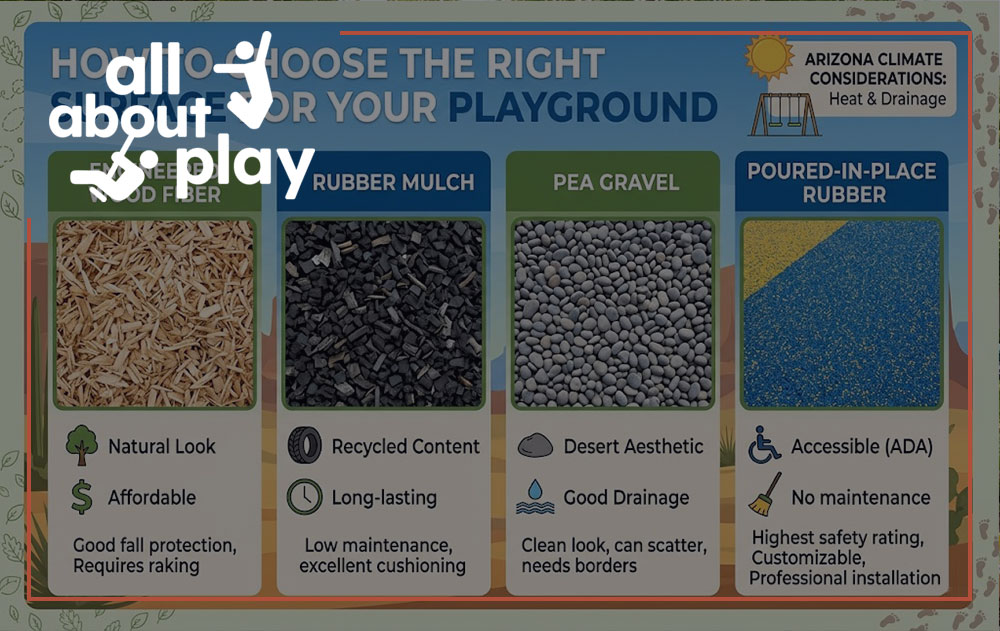
Wood chips are one of the most widely used playground surfaces, and for good reason. They’re affordable, widely available, and provide solid fall protection when installed at the right depth (typically 9–12 inches for most playsets).
Engineered wood fiber (EWF) takes this a step further. Unlike basic wood chips, EWF is specifically processed to interlock and resist compaction, providing more consistent cushioning. It’s also compliant with ADA accessibility guidelines, making it a strong choice for families with children of varying abilities.
Pros: Affordable, good fall protection, natural look, widely available
Cons: Requires regular raking to maintain even depth, can decompose over time, may attract insects or fungi in damp areas
Best for: Families looking for a cost-effective, natural-looking option with solid safety credentials
2. Rubber Mulch
Rubber mulch—typically made from recycled tires—has grown significantly in popularity over the past decade. It doesn’t decompose, doesn’t attract pests, and holds its depth far better than wood chips over time. In the Arizona heat, it also stays cooler than solid rubber tiles, though it can still get warm on peak summer days.
When installed at the proper depth, rubber mulch provides excellent fall protection. Many parents also appreciate that it doesn’t track into the house on little shoes the way wood chips sometimes do.
Pros: Long-lasting, low maintenance, excellent fall protection, doesn’t decompose
Cons: Higher upfront cost than wood chips, can get warm in direct sun, not as aesthetically natural
Best for: Families who want a durable, low-maintenance option and don’t mind the higher initial investment
3. Pea Gravel
Pea gravel is a smooth, rounded stone that provides decent drainage and a clean, classic look. It’s a popular choice in Arizona backyards because it pairs well with desert landscaping and doesn’t break down in the heat.
That said, pea gravel has some notable drawbacks. Small stones can scatter outside the play zone, get into shoes, and become projectiles in the hands of young children. It also requires borders to keep it contained, and the rocks can compact over time, reducing fall protection.
Pros: Good drainage, clean look, doesn’t decompose, fits desert landscaping
Cons: Can scatter, poses a choking hazard for very young children, can compact over time
Best for: Families with older children in dry climates who want a low-cost, natural look
4. Rubber Tiles and Poured-in-Place Rubber
For a premium surface with maximum safety, rubber tiles and poured-in-place rubber are hard to beat. These surfaces are firm, consistent, and ADA-compliant. They don’t shift, don’t compact, and don’t need to be raked or replenished.
Poured-in-place rubber—sometimes called “PIP”—is a two-layer system applied directly to a prepared base. The bottom layer absorbs impact; the top layer provides the wear surface and can be customized in colors and patterns. It’s commonly seen at commercial playgrounds, but homeowners are increasingly choosing it for backyard playsets.
Pros: Highest safety ratings, fully accessible, no maintenance, highly customizable
Cons: Most expensive option, can get hot in direct sunlight in desert climates, professional installation required
Best for: Families who want a permanent, professional-grade surface and are willing to invest for the long term
5. Sand
Sand is one of the oldest and most traditional playground surfaces. Kids love it—the tactile experience alone adds a whole other dimension of play. It provides good fall protection when maintained at the right depth and drains well in most conditions.
The downside? Sand requires significant upkeep. It compacts under heavy use, disperses easily, and in Arizona’s monsoon season can become waterlogged and difficult to dry out. It’s also a favorite hangout for neighborhood cats, which is something to consider.
Pros: Affordable, good fall cushioning, kids love it, easy to find
Cons: Compacts quickly, disperses beyond the play area, requires regular maintenance, not ADA-compliant
Best for: Younger children with an engaged parent or caregiver willing to maintain depth and cleanliness
6. Artificial Turf
Artificial turf has become an increasingly popular choice in Arizona, where maintaining natural grass is expensive and water-intensive. When installed with an appropriate shock-absorbing pad underneath, modern artificial turf can meet safety requirements for playsets and swing sets.
It looks great, stays clean, and works well in backyards where the playground is part of a larger outdoor living setup. Keep in mind that surface temperatures can spike in direct Arizona sunlight—choose a product with heat-reduction technology if possible, and inspect it regularly for wear around high-impact zones.
Pros: Clean, attractive, low water use, works well in desert climates with the right underpad
Cons: Can get extremely hot in direct sunlight, requires an underpad for fall protection, higher installation cost
Best for: Families integrating a playset into a broader backyard landscape design
Key Factors to Consider When Choosing a Surface
The Age of Your Children
For toddlers and young children, you’ll want a surface that’s both soft and free of choking hazards. Engineered wood fiber, rubber mulch, and rubber tiles are all strong options. Pea gravel is generally not recommended for children under five.
The Height of Your Equipment
The higher the play structure, the more critical the fall protection rating of your surface. A multi-level swing set or large playset needs a deeper layer of loose-fill material, or a higher-rated rubber surface, compared to a low-platform playhouse. Always check the critical fall height rating of any surface material you’re considering and match it to the height of your equipment.
Arizona’s Climate
Heat is a real factor in Phoenix, Mesa, and the surrounding areas. Materials like black rubber tiles or dark rubber mulch can absorb significant heat during summer afternoons. Consider surfaces with lighter colors, or plan for shade structures over the play zone. Wood chips and engineered wood fiber tend to stay cooler than rubber alternatives in direct sun.
Drainage is equally important. Monsoon storms can drop large amounts of rain quickly. A surface with poor drainage turns into standing water—not ideal for a playset or swing set. Pea gravel, EWF, and rubber mulch all drain well when installed over a proper base.
Your Maintenance Commitment
Loose-fill materials like wood chips and sand require regular maintenance—raking, replenishing, and monitoring for compaction. If low maintenance is a priority, rubber tiles or poured-in-place rubber are worth the higher upfront cost. Rubber mulch sits somewhere in the middle: it needs less maintenance than wood but still benefits from occasional redistribution.
Budget
Costs vary widely across surface options. Wood chips and pea gravel are among the most affordable, while poured-in-place rubber and high-quality artificial turf sit at the higher end. It’s worth thinking about total cost over time—not just the sticker price. A budget surface that needs replacing every two years can end up costing more than a durable option installed once and maintained well.
How Much Surface Coverage Do You Need?
The standard guideline is to extend your surfacing material at least 6 feet beyond the perimeter of your playset in all directions. For swing sets specifically, extend the surface coverage to the front and back of the swing by a distance of twice the height of the top bar. So if your swing set’s top bar is 8 feet high, you’d want at least 16 feet of coverage in front of and behind the swings.
This extra space accounts for the arc of the swing and landing zones where falls are most likely to happen.
Don’t Forget the Border
A containment border keeps loose-fill materials in place and gives the play area a defined, polished look. Common border options include:
- Landscape timbers or railroad ties — affordable and sturdy
- Rubber curbing — flexible, durable, and child-safe
- Brick or stone edging — attractive, but can be a tripping hazard if not installed flush
- Plastic playground borders — lightweight, easy to install, and available in multiple colors
Whatever you choose, make sure the border doesn’t create a tripping hazard at the edges of the play area.
Frequently Asked Questions
What is the safest surface for a backyard swing set?
Poured-in-place rubber and rubber tiles consistently earn the highest safety ratings. For loose-fill options, engineered wood fiber provides reliable cushioning when installed at the correct depth. The safest choice for your specific setup depends on the height of the equipment and how well the surface is maintained.
How deep should wood chips be under a playset?
Most safety guidelines recommend a minimum depth of 9 inches of wood chips or engineered wood fiber for playsets with fall heights of up to 10 feet. Because loose-fill materials compact over time, it’s a good practice to start with 12 inches and top up regularly.
Is rubber mulch safe for children?
Yes. Modern rubber mulch made from recycled tires is widely used and considered safe for playground use. Look for products that have been tested for heavy metals and other contaminants, and choose a reputable supplier.
What playground surface works best in Arizona’s heat?
Engineered wood fiber and lighter-colored rubber mulch tend to stay cooler than dark rubber tiles or poured-in-place surfaces. Artificial turf with heat-reduction technology is also a good option. Regardless of surface material, adding a shade sail or canopy over the play area makes a significant difference during peak summer months.
Can I use concrete or asphalt under a playset?
No. Hard surfaces like concrete and asphalt provide no fall protection and are not suitable under any play equipment with an elevated fall height. These surfaces dramatically increase the risk of serious injury from falls.
Ready to Build the Perfect Backyard Playground?
Choosing the right surface is one piece of the puzzle. The other is making sure you have high-quality, safe playground equipment to go along with it. At All About Playgrounds, we carry a full range of playsets, swing sets, trampolines, basketball goals, and more—all built to last and backed by a lifetime product warranty.
Our team has decades of experience helping Arizona families set up backyard play spaces that kids love and parents trust. We offer free delivery and assembly throughout the Phoenix metro area, and our free in-home consultations take the guesswork out of choosing the right equipment and layout for your yard.
Have questions about surfacing, spacing, or which playset is right for your family? Contact All About Playgrounds today—our friendly team is ready to help you build a backyard your kids will never want to leave.